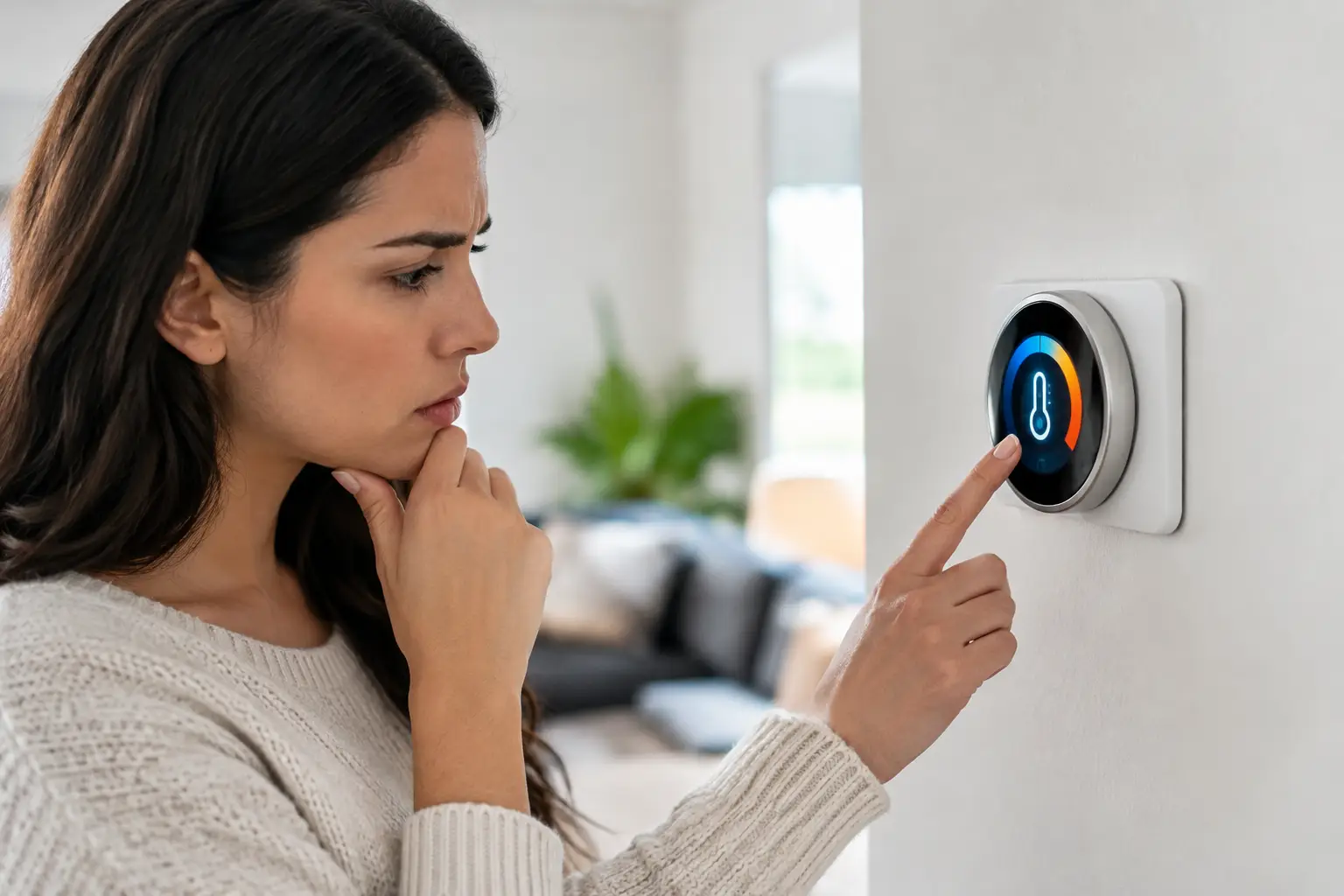
You set the thermostat to 72, but the house stays at 67. When a thermostat not reaching set temperature problem shows up, it can make a Miami Valley winter night or humid Ohio afternoon feel much longer. The thermostat may be calling for heating or cooling correctly, but a separate issue may be keeping the system from delivering enough comfort.
Before assuming the thermostat itself has failed, take a few simple checks. A filter, power issue, airflow restriction, or outdoor-unit problem can all produce the same frustrating result. The goal is to rule out the safe, obvious causes first, then bring in a technician before a small issue turns into a no-heat or no-cooling call.
Why Your Thermostat Is Not Reaching Set Temperature
A thermostat is a control, not the part that creates heat or cooling. It measures the air around it and tells the furnace, air conditioner, or heat pump when to run. If the indoor temperature does not catch up, the thermostat may be inaccurate, the equipment may not be producing enough conditioned air, or that air may not be moving through the home as it should.
The timing also matters. On an extremely cold or hot day, a correctly sized system may run for long stretches. It may even fall a few degrees behind during weather that is well outside normal design conditions. That is different from a system that cannot maintain temperature on an ordinary day, short-cycles on and off, or runs constantly with weak airflow.
The thermostat setting or mode is incorrect
Start with the basics. Confirm the thermostat is set to Heat when you need heat or Cool when you need cooling. Make sure the fan is set to Auto rather than On. With the fan set to On, it continues circulating air between heating or cooling cycles, which can make vents feel cool during the winter or warmer during the summer.
Check that the programmed schedule has not changed the temperature behind the scenes. Smart and programmable thermostats may follow a weekday schedule, an energy-saving setting, or an app-based automation that overrides what you selected manually.
If the thermostat uses batteries, replace them with fresh batteries. Low batteries can cause display issues or unreliable operation on some models. If the screen is blank, check the furnace or air-handler power switch and the circuit breaker before doing anything else.
A dirty air filter is limiting airflow
A clogged filter is one of the most common reasons a home struggles to heat or cool evenly. Your HVAC system needs steady airflow across its indoor components. When the filter is packed with dust, pet hair, or debris, the blower has to work harder and less air reaches the rooms that need it.
In heating mode, restricted airflow can cause a furnace to overheat and shut down on a safety limit. In cooling mode, it can contribute to a frozen indoor coil. Either condition can leave the thermostat calling for comfort while the system is unable to keep up.
Check your filter monthly and replace it as needed. Homes with pets, allergies, remodeling dust, or frequent system use may need more frequent changes. Use the filter type and size recommended for your equipment. A very restrictive filter is not always better if your system was not designed for it.
Closed vents, blocked returns, or duct problems
Supply vents deliver conditioned air into a room. Return grilles pull household air back to the HVAC equipment. Both need room to work. Closed vents, furniture covering a return, thick curtains, or rugs blocking low wall grilles can create comfort problems and strain the system.
Walk through the home and make sure supply registers are open and return grilles are clear. It is fine to adjust a vent slightly for comfort, but closing several vents to force air elsewhere is rarely a good long-term fix. It can increase duct pressure and reduce overall airflow.
Leaky, undersized, disconnected, or poorly balanced ductwork can also leave certain rooms behind. This is especially common in finished basements, room additions, bonus rooms, and upper floors. If one part of the house is consistently uncomfortable while other rooms are fine, the issue may be distribution rather than the thermostat.
The outdoor unit or heat pump is not operating normally
During air-conditioning season, the outdoor unit should run when the thermostat calls for cooling. If the indoor blower runs but the outdoor unit does not, you may get little or no cooling. A tripped breaker, failed electrical component, refrigerant issue, or outdoor-unit problem could be involved.
For a heat pump in winter, the outdoor unit may run even while you feel cooler air from the vents than you expect. Heat pumps produce gentler heat than a gas furnace, and they periodically enter a defrost cycle to remove frost from the outdoor coil. During defrost, auxiliary heat may operate to keep indoor comfort steady.
Heavy ice buildup on a heat pump, unusual grinding noises, repeated breaker trips, or a system that only blows cool air are reasons to schedule professional service. Do not chip ice off the outdoor unit or keep resetting a breaker that trips again.
Safe Checks Before You Schedule Service
A few homeowner checks can help identify a simple issue and give your technician useful information. Avoid removing equipment panels or handling electrical components.
- Verify the thermostat mode, temperature setting, fan setting, and batteries.
- Replace a visibly dirty filter with the correct size and orientation.
- Confirm the HVAC breaker is on and the nearby equipment switch has not been turned off.
- Open supply vents and clear furniture, storage, and rugs away from return grilles.
- Look for obvious signs such as ice, water around the equipment, unusual noises, or an outdoor unit that will not run.
If you have a standard furnace and the thermostat is calling for heat, you can also look through the furnace viewing window for a blinking diagnostic light. Write down the flash pattern rather than attempting a repair based on the code. A technician can use that information as part of an accurate diagnosis.
When the Thermostat Is the Actual Problem
Thermostats do fail, but they are often blamed for problems that begin elsewhere. A thermostat is more likely to be the issue if its displayed room temperature is clearly wrong, its screen is unresponsive, it does not call for heating or cooling when it should, or it turns the system on and off too quickly.
Location can affect accuracy as well. A thermostat installed near a sunny window, exterior door, kitchen, supply vent, lamp, or fireplace can sense a temperature that does not represent the rest of the house. A wall cavity behind the thermostat can also allow drafts to affect the reading.
A thermostat replacement may solve the problem, but compatibility matters. Heat pumps, multi-stage furnaces, dual-fuel systems, humidifiers, and smart-home controls may need specific wiring and setup. Installing the wrong thermostat or programming it incorrectly can reduce comfort and efficiency.
Signs the HVAC System Needs Professional Attention
Schedule service if the system runs continuously without improving the indoor temperature, cycles on and off every few minutes, or produces weak airflow throughout the house. You should also call for help if you smell burning or gas, hear loud mechanical noises, see water leaking, find ice on refrigerant lines, or experience repeated breaker trips.
For gas-furnace concerns, leave the home and contact the gas utility or emergency services if you smell gas. If a carbon monoxide alarm sounds, get everyone outside immediately and call emergency services. Carbon monoxide safety is never a wait-and-see situation.
A professional diagnostic visit should go beyond swapping a thermostat. The technician should check thermostat operation, electrical controls, filter condition, airflow, temperature rise or drop, safety switches, and the performance of the furnace, air conditioner, or heat pump. That process identifies the actual cause and helps avoid paying for a part that was never needed.
Preventing Another Set-Temperature Problem
Regular maintenance is the best way to catch many comfort issues before the weather becomes severe. Seasonal service can identify worn electrical parts, dirty coils, drainage concerns, airflow restrictions, and combustion or refrigerant-performance issues while the system is still operating.
It also helps to watch patterns. Note whether the issue happens only during extreme weather, only in one room, only at night, or after a recent filter change or thermostat adjustment. Those details can point toward equipment capacity, ductwork, insulation, thermostat placement, or a developing mechanical issue.
For homeowners in Troy, Piqua, Tipp City, and nearby communities, Fusion Heating and Air can diagnose why your system is falling behind and explain the practical repair options clearly. The right next step is not always a replacement. Sometimes it is a filter, control, airflow correction, or focused repair that gets your home comfortable again.
Comfort should not be a daily guessing game. If the temperature on the wall and the temperature in your home do not match, a careful diagnosis can give you a clear path back to dependable heating and cooling.
Leave a Reply